
Kia Sportage: Recommended lubricants and capacities
To help achieve proper engine and powertrain performance and durability, use only lubricants of the proper quality. The correct lubricants also help promote engine efficiency that results in improved fuel economy. These lubricants and fluids are recommended for use in your vehicle.
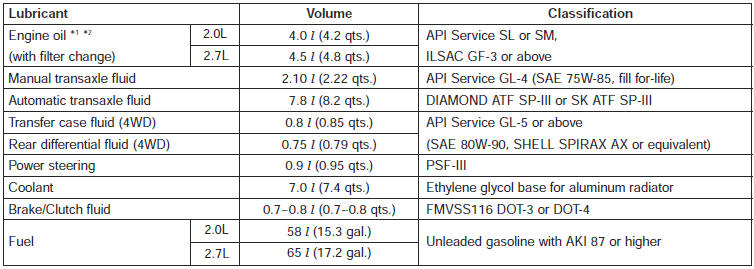
*1 Refer to the recommended SAE viscosity numbers on the next page. *2 Engine oils labeled Energy Conserving Oil are now available. Along with other additional benefits, they contribute to fuel economy by reducing the amount of fuel necessary to overcome engine friction. Often, these improvements are difficult to measure in everyday driving, but in a year’s time, they can offer significant cost and energy savings.
Recommended SAE viscosity number
CAUTION Always be sure to clean the area around any filler plug, drain plug, or dipstick before checking or draining any lubricant. This is especially important in dusty or sandy areas and when the vehicle is used on unpaved roads. Cleaning the plug and dipstick areas will prevent dirt and grit from entering the engine and other mechanisms that could be damaged.
Engine oil viscosity (thickness) has an effect on fuel economy and cold weather operating (starting and oil flow). Lower viscosity engine oils can provide better fuel economy and cold weather performance, however, higher viscosity engine oils are required for satisfactory lubrication in hot weather. Using oils of any viscosity other than those recommended could result in engine damage. When choosing an oil, consider the range of temperature your vehicle will be operated in before the next oil change. Proceed to select the recommended oil viscosity from the chart.
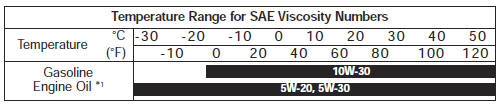
1. For better fuel economy, it is recommended to use the engine oil of a viscosity grade SAE 5W- 20, 5W-30 (API SL, SM / ILSAC GF-3). However, if the engine oil is not available in your country, select the proper engine oil using the engine oil viscosity chart.
 Specifications
See also:
Automatic heating and cooling control system
(If installed)
Your Hyundai is equipped with an automatic
heating and cooling control system controlled
by simply setting the desired temperature.
TYPE A (Without A.Q.S: Air Quality System)
TYPE B (With A.Q.S: Air Quality System)
Heatin ...
Emergency starting
Jump starting Jump starting can be dangerous if done incorrectly. Therefore,
to avoid harm to yourself or damage to your vehicle or battery, follow the jump
starting procedures listed on page 6-6. If in doubt, we strongly recommend that
you hav ...


